

Airborne particles
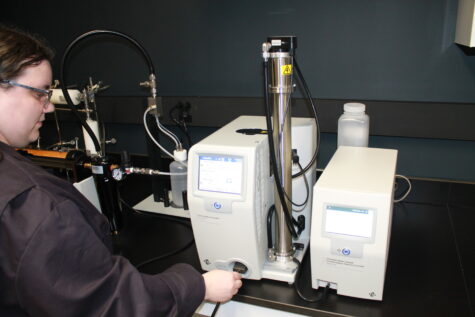 Atmospheric particles, also known as particulate matter or PM, are one of the most chemically complex components of the atmosphere, as they are typically composed of hundreds or thousands of organic and inorganic species. Although measurements of total PM2,5 (particles with a diameter of less than 2.5 µm) are relatively common and carried out by most government monitoring stations in Quebec, these data do not provide any information on the particle size distribution or the particle composition, which is essential for understanding exposure risk. The platform is equipped with a variety of instruments, including samplers and continuously mobile instruments, to characterize the entire chemical composition of airborne particles (metals, organic compounds, ammonium, sulfate, etc.) as well as their size distribution between 10 nm – 10,000 nm. The platform has an Aerosol Chemical Speciation Monitor to continuously measure the chemical composition of PM2,5, as well as a Scanning Mobility Particle Sizer, an Optical Particle Counter and a Condensation Particle Counter to measure the total concentrations of PM2,5 and ultrafine particles (PM0,1). We also have airborne particle generation systems that can produce polydisperse or monodisperse aerosols.
This content has been updated on 20 June 2024 at 10h22.